Priory Park has been described as the “jewel in the crown” of Chichester. It is a precious open space, administered and maintained by Chichester District Council and enjoyed by thousands of people every year. It is the venue for cricket, football and bowls as well as being a space in which families, friends and individuals can peacefully relax, as well as enjoying many other celebrations from time to time, such as the Chichester Gala, film shows and a lot more.
The Priory Park Society is an active group of people who use, or simply care about the park and wish to support, collaborate – and sometimes challenge – the councils’ plans for it. Two years ago, we provided a defibrillator for the park and are always looking out for projects through which we can make a contribution to its fabric and upkeep.
The Priory Park Society is made up of people who bring a wide cross section of professional experience, as well as other gifts, and our meetings are also attended by councillors and other who represent CDC and CCC.
Priory Park encapsulates nearly 2000 years of Chichester’s history within its bounds. Here is a very brief account of how it came to be the park we know and love today.
The Romans
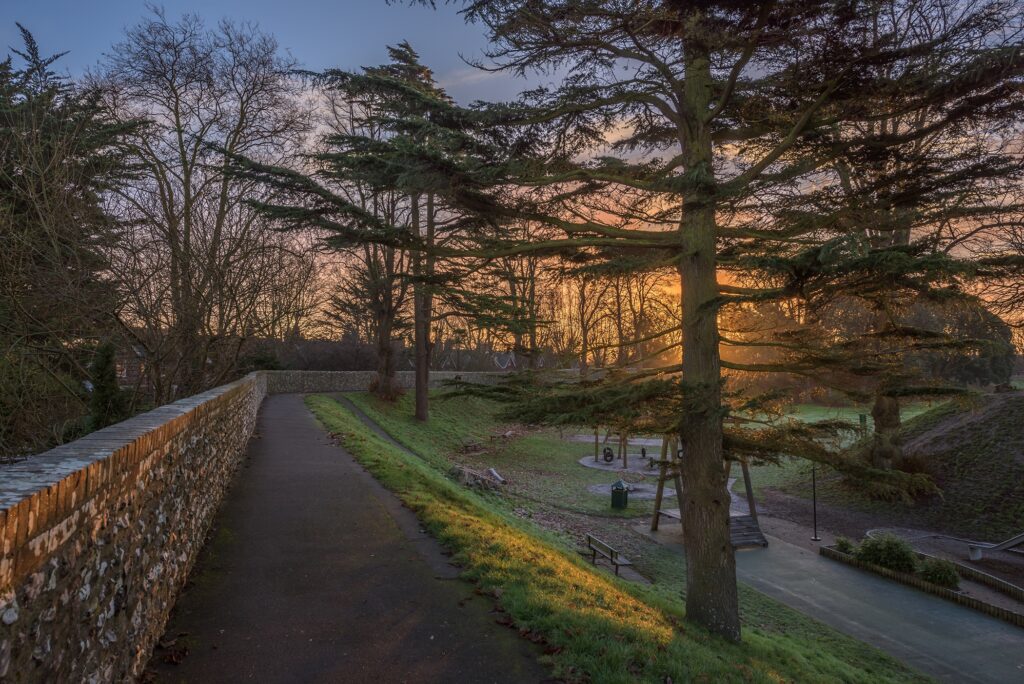
In Roman times this was the posh part of the city with grand dwellings and a bath house, as recent archaeological digs have revealed. The Roman walls, which mark the northern and eastern boundaries of the park, were added in the second century AD but the flint facings we see today are medieval.
The Roman East Walls today – they are a Scheduled Ancient Monument.
The Normans
In medieval times it became a Norman motte-and-bailey castle, built c1080 to impose William the Conqueror’s tyrannical rule on Chichester. The bailey extended out to the Roman walls and what is now Priory Road. Archaeological evidence has shewn that the motte would have been surrounded by a moat. The castle was destroyed by Henry Marshall in 1217 and all that remains now is the motte, now generally known as The Mound. It was probably much bigger when built but has eroded away over time. In Victorian times a garden was added, shrubs planted and paths laid out to get to the top. These accretions were removed in 2011 to restore something of the appearance of a motte.
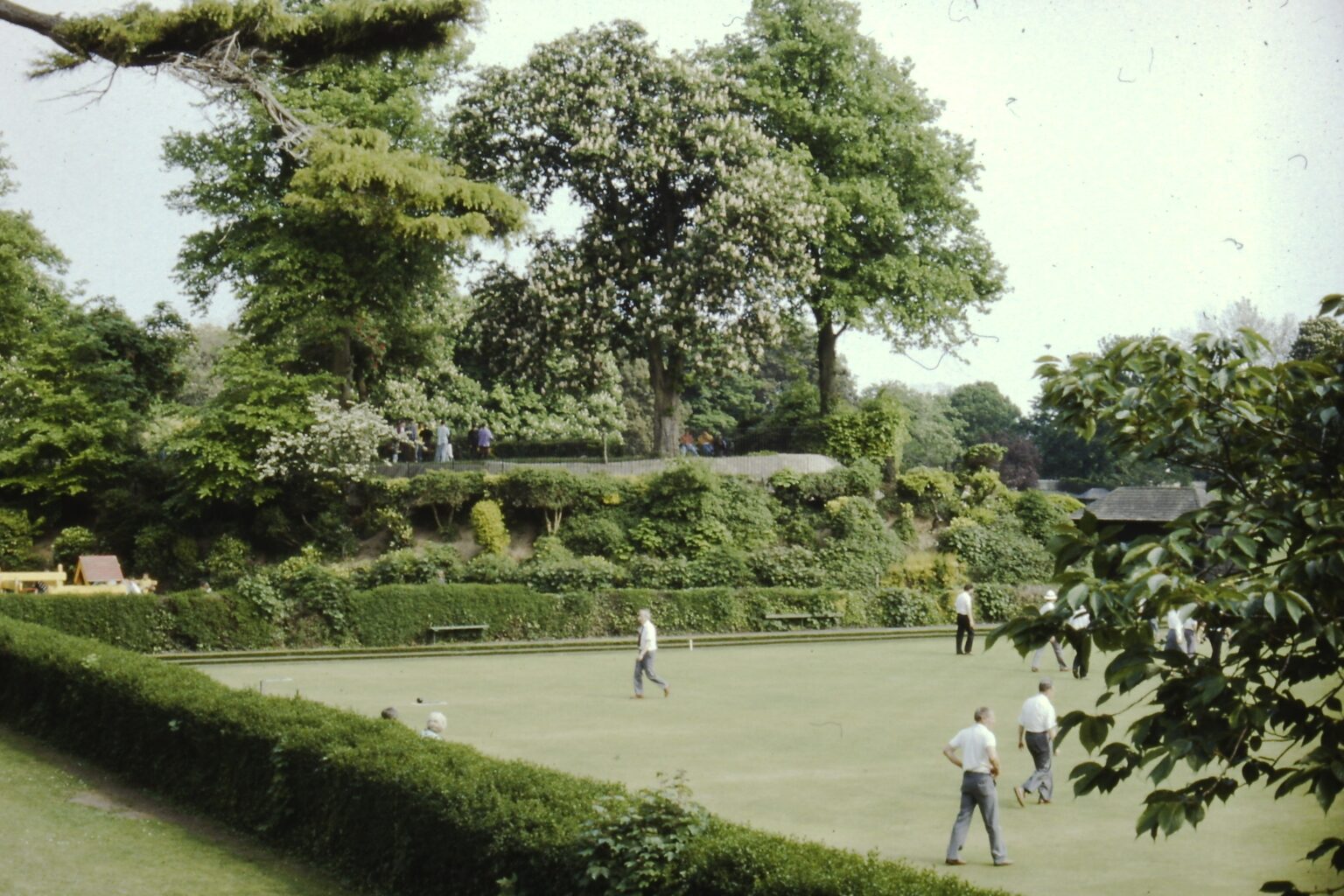
The mound (which is also a Scheduled Ancient Monument) seen in the 1970s when it still had its Victorian additions. The Bowling Green is in the foreground.
The Grey Friars
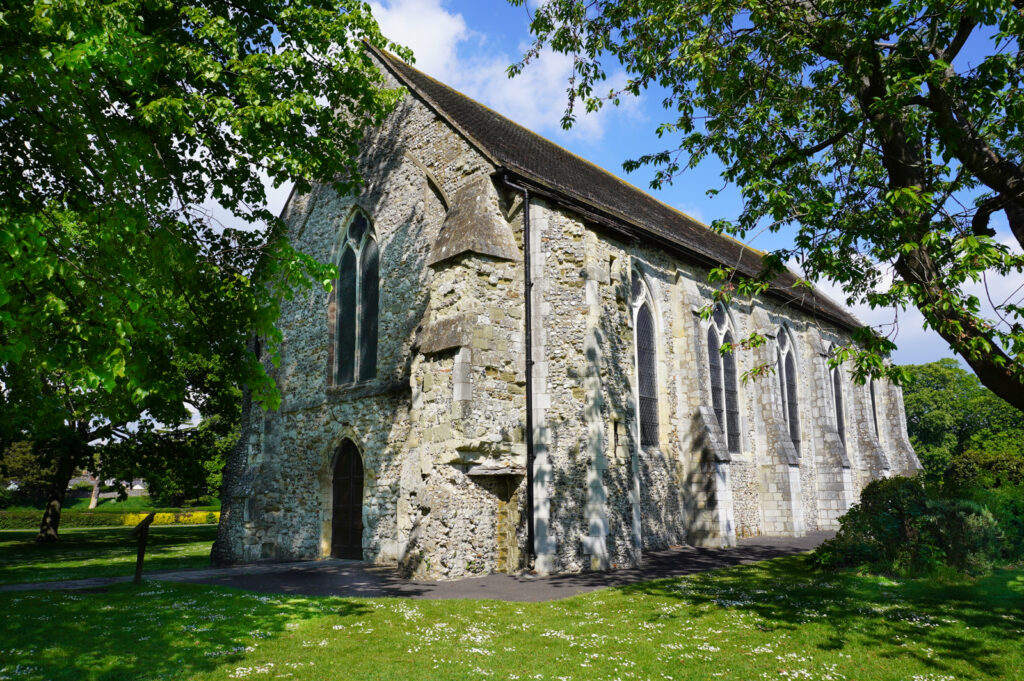
In 1269 the castle was gifted by Henry III to the Franciscans (the Grey Friars) who used it to build a friary with a range of monastic buildings. At the Dissolution of the Monasteries by King Henry VIII in 1538 the friary was closed and over the next 300 years most of the buildings disappeared with only the friary church and part of the ruined hospitium now remaining.
Priory Park Guildhall
The Guildhall
In medieval times it became a Norman motte-and-bailey castle, built c1080 to impose William the Conqueror’s tyrannical rule on Chichester. The bailey extended out to the Roman walls and what is now Priory Road. Archaeological evidence has shewn that the motte would have been surrounded by a moat. The castle was destroyed by Henry Marshall in 1217 and all that remains now is the motte, now generally known as The Mound. It was probably much bigger when built but has eroded away over time. In Victorian times a garden was added, shrubs planted and paths laid out to get to the top. These accretions were removed in 2011 to restore something of the appearance of a motte.
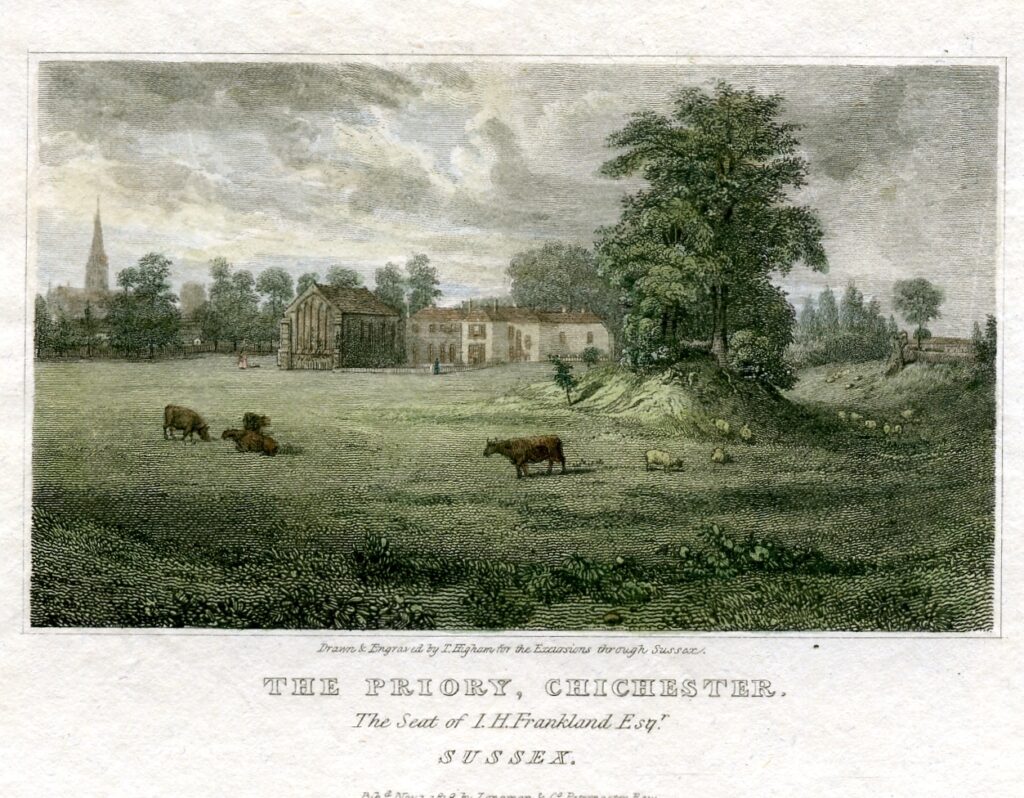
Admiral Frankland’s house in Priory Park seen in an engraving of 1819. Note the cattle grazing in what were then private grounds.
The Beginning of the Park
Enter the Duke of Richmond
In the early 19th century the 4th Duke of Richmond took on the lease of the house and park and in 1824 he purchased the freehold from the Corporation. At this time he was High Steward to the city. The house had lain empty since 1831 and the Duke demolished it in 1838. He only seems to have used the park for grazing his cattle but that was all to change in 1850.
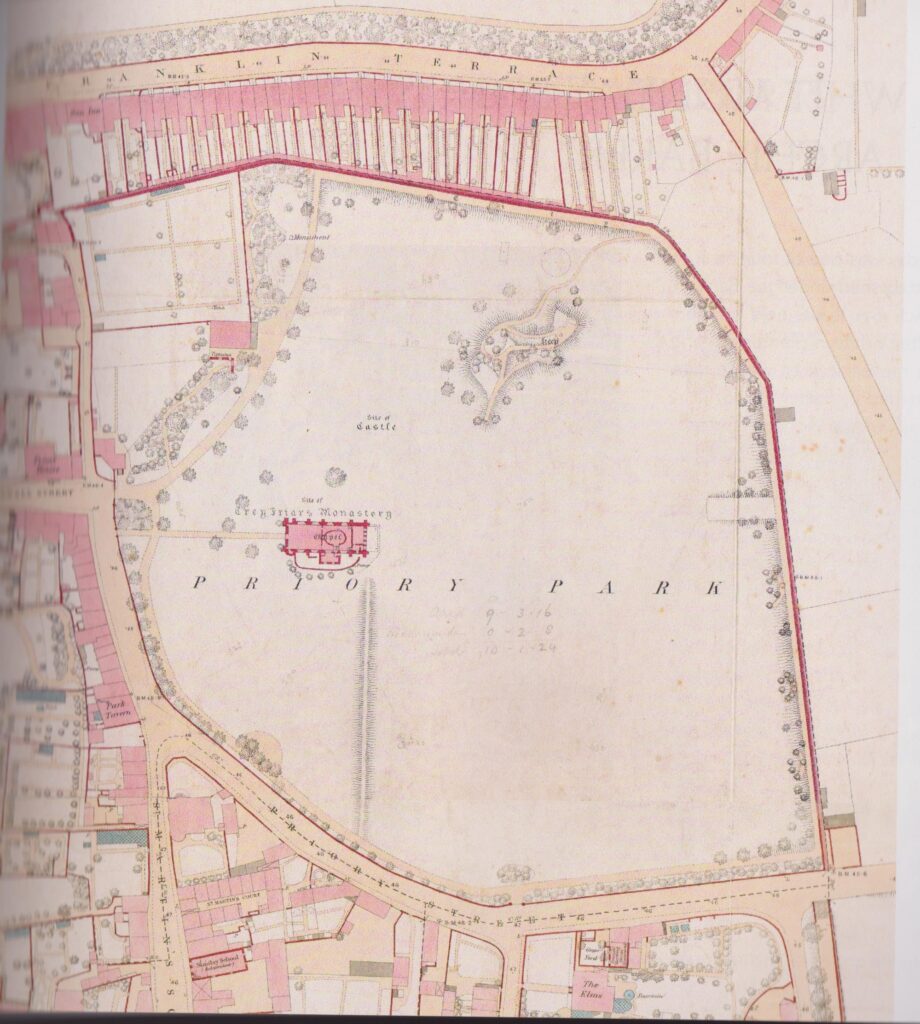
An extract from the 1875 OS at 1:500 scale shewing the layout of the private park
The Private Priory Park
The 5th Duke of Richmond leased the park to the newly-formed Priory Park Society in 1850 and they set about transforming it into ornamental grounds with tennis courts, cricket pitches and a bowling green, all for healthy outdoor recreation. A refreshment room was built near the hospitium ruins and a lodge provided at the entrance to house the park keeper. The walls to the guildhall path were demolished to open up the park.
It opened on 15 May 1851 but entry to the park was not free – you could either subscribe as a member and have your own key or pay to be a temporary visitor on the recommendation of a subscriber. The park was also used for public events such as Empire Day, Whit Monday Sports and civic occasions such as marking coronations and jubilees. The first cricket match was held on 7 August 1851and the great W G Grace played here in in 1871, but the cricket pavilion was not to be added to the facilities until 1908. Sussex last played a county match here in 1950.
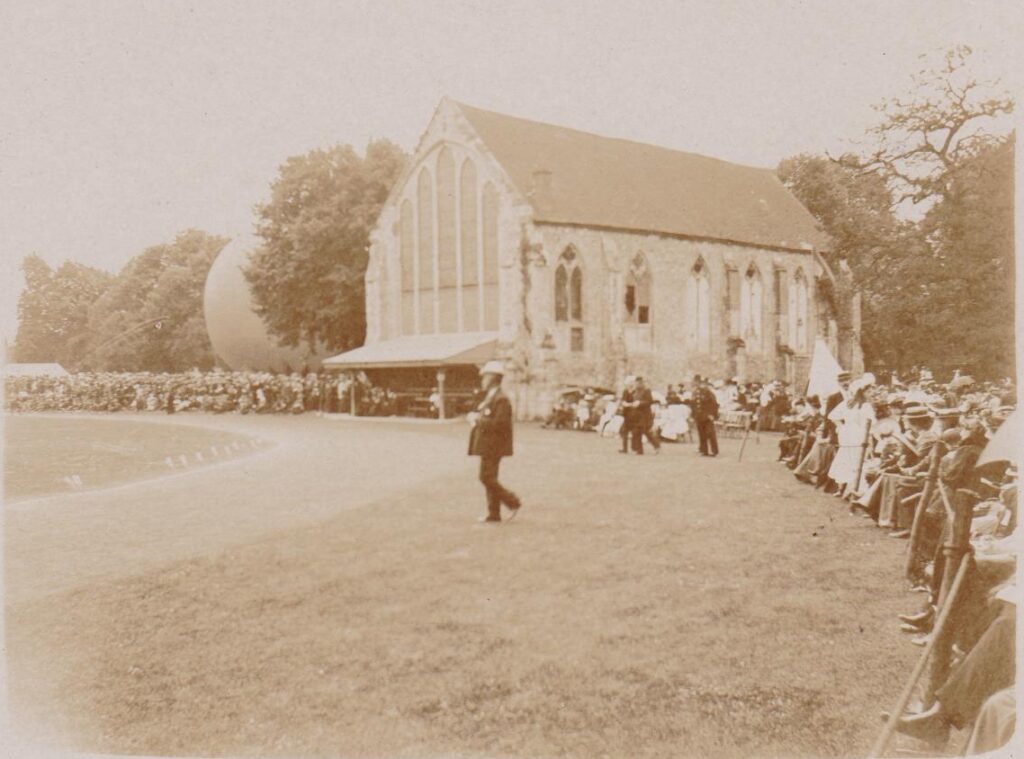
The annual Whit Monday sports in Priory Park in Edwardian times. Note the mown race track and the inflated balloon tethered in the background whose ascent would no doubt round off the day’s proceedings
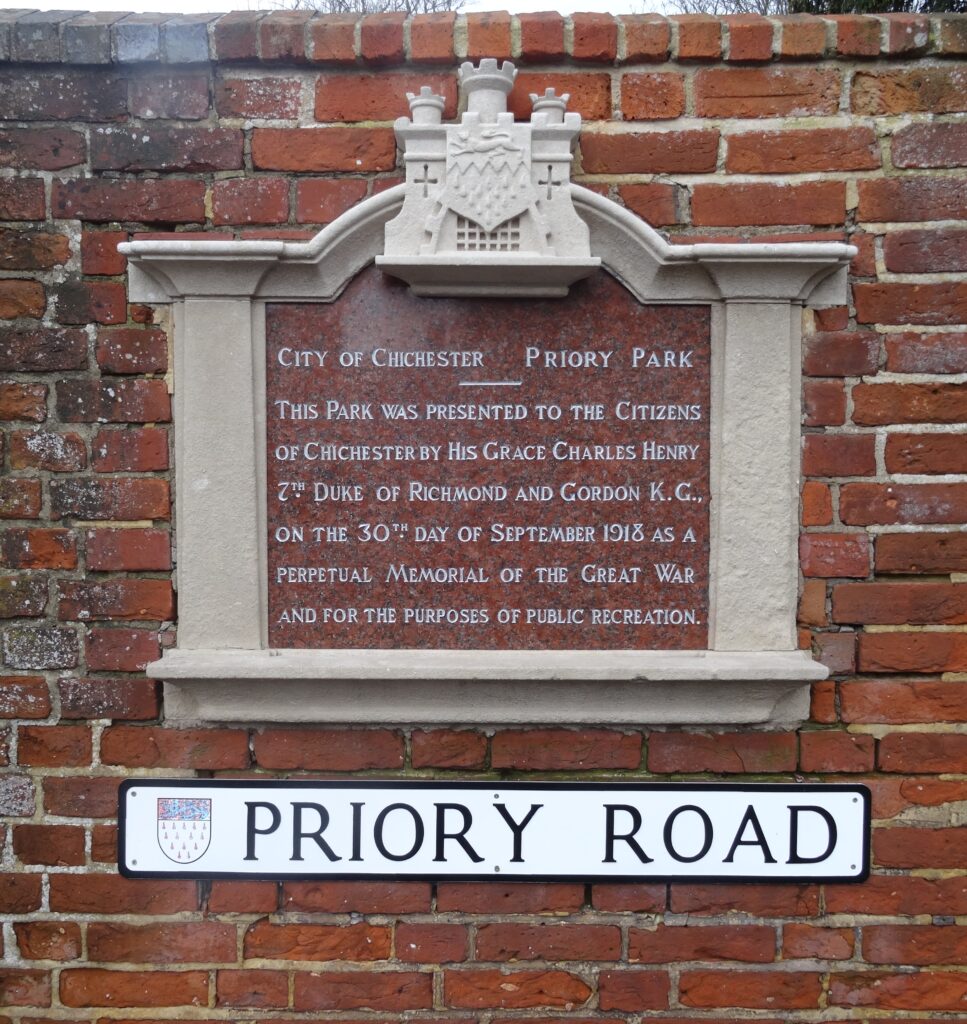
The plaque commemorating the gift of Priory Park to the city. It was designed by George Herbert Catt who taught at Chichester School of Art. It was restored in 2018 as part of the Priory Park 100 celebrations marking the centenary of the public park
The Public Priory Park
The Priory Park Society was wound up and entry to the park was now free to all. Sports continued with the addition of hockey, and in 1949 the Guildhall became a museum. In 1955 the first ever Gala Day was staged raising money for local charities. Priory Park was the location for the arena events and the fun fair. Always held on the first Saturday in July it flourished for over 30 years but sadly petered out during the early 1990s.
In September 2018 the centenary of the public Priory Park was marked by a week of events culminating in Sussex County Cricket Club coming back to the park to play against the Duke of Richmond’s XI.
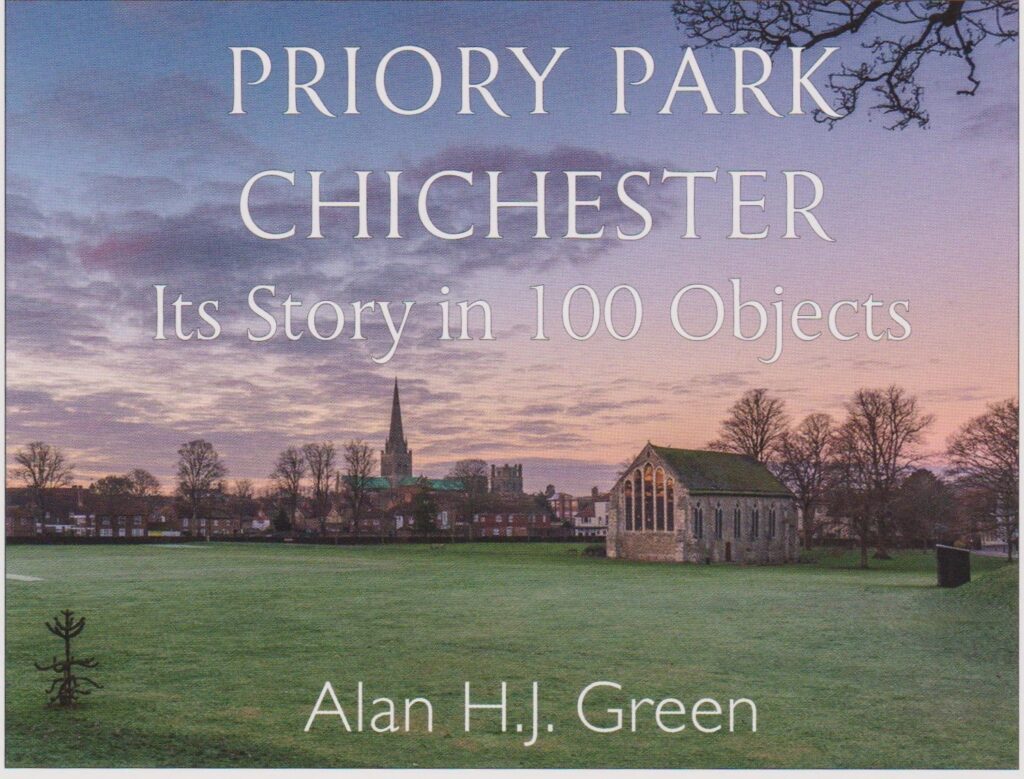
For a detailed history of Priory Park see Priory Park : Its History in 100 Objects by Alan H J Green (ISBN 978-0-9934680-6-3). It was published as part of the Priory Park 100 celebrations and copies can be obtained at West Sussex Record Office and the Novium Museum.